Sunday, May 16, 2010

It's almost over...


All the final papers are done, right? You're probably just proof reading now while you kick back with a beer, read Cahiers du Cinema, and handicap the offerings at Cannes this year, right?

Me? I'm working on the usual end-of-the-semester battle-field mop-up. Sadly, the cinema analogue this semester is more Tropic Thunder:


than Apocalypse Now:


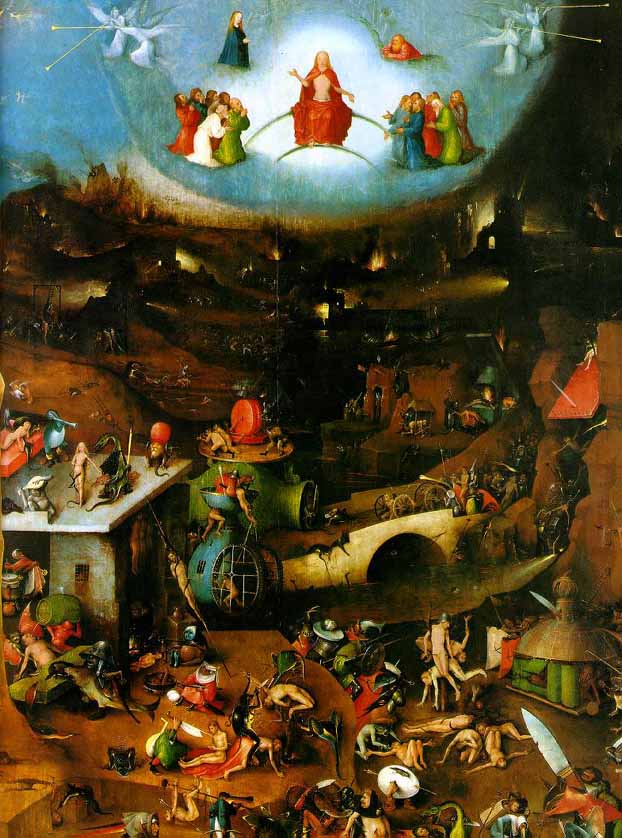
Thom correctly guessed our final film will be In Bruges. To prepare, here is a thoughtful review from Christianity Today and a look at the Groeninge Museum's Hieronymus Bosch, Last Judgment triptych that plays such an important role in the film:

Monday, May 10, 2010

Thoughts on final paper...logs...class...


Tomorrow we can use the entire class period to discuss, work on, explore anything pertinent to the film Freeway, to the final paper, to final class work in general, and to the final moment of institutional closure---the final grade.

To get you thinking, let me quote from the final essay assignment, one of the last texts of our course, AND the syllabus, the first text of our course.

From the final assignment:

...that said, there are students who are still woefully behind, in terms of handing work in and in terms of even understanding what we’ve been doing in class. And nearly everyone could stand to take the logs more seriously---after all, completing the logs is a requirement for passing the course, at the very least.

...for those who have truly been students, this paper should be seen as a challenging opportunity to present a polished example of what you’ve gained over the semester. For those who have been occupying seats in the classroom, this paper is a last chance to try to turn something in.

And from the syllabus:

...the log functions as a space where students can begin to critically reflect on their practices as “film fan,” “movie goer” “spectator,” and “reader.” The log provides a place for students to react to and reflect on the films screened that week, that week’s class discussion and reading, as well as remarks on the discussion and films in previous classes---in other words, the log should reflect the incremental development of the student’s ideas throughout the course. Besides being a place to begin to work on the ideas generated in specific class sessions, the log can also provide a space for students to make connections between ideas and issues beyond what can be included in individual class sessions...you must turn in a complete log in order to pass the class.

Bonus prize: If you are reading this, please comment below. Anyone commenting will be looked upon favorably during the final reckoning.

Wednesday, May 5, 2010

Exploitation films

For our discussion of genre-riffing in Freeway, I suggested that we look at the "exploitation film." However, this term is less defined than classic narrative genres like "horror," and also considerably less historically dense. The term "exploitation" comes from a tag originally attached to low budget projects which attempted to turn a profit by exploiting super-sensationalistic treatments of sex and/or violence. The useful summary found in Wikipedia begins with this history: "Exploitation films feature uncut unrated material. They specialize in numerous sex and nudity scenes, bloody gore, violent nonsense, and taboos...[they] may feature suggestive or explicit sex, sensational violence, drug use, nudity, freaks, gore, the bizarre, destruction, rebellion, and mayhem." Clearly, however the term is now applied to a variety of cultural products, an over-the-top approach to plot elements and eccentric subject matter being one of the defining elements.

A good overview of the category's history can be found here, a discussion which emphasizes that the appreciation of the genre is based in the enjoyment of that which is usually excluded from mainstream film, including the ever subjective notion of "bad taste." Bright Lights Film Journal has a index of articles on various examples of exploitation films; just reading the titles should give you a good idea of the kind of thing the term embraces.

Of course, "exploitation" has itself recently become a highly layered, ironic, and self-referential genre: case in point is the film featured in the previous post, Machete. A self-consciously "mexploitation" film directed by Robert Rodriguez (and produced by irony-master Quentin Tarantino) Machete plays not only with the genre's eccentric stylistic conventions, it carries its knowing irony over into the casting of has-been stars (Don Johnson), genre jokes (Steven Segal), cult regulars (Danny Trejo), slumming serious actors (Robert De Niro) conventional sex kittens (Jessica Alba) and all-purpose celebrity train wrecks (Lindsay Lohan). This is not the kind of film the term "exploitation" originally denoted, instead the label now references a kind of over-the-top meta entertainment dependent on knowledge of mainstream and fringe film, campy genres, and pop culture in-jokes.

It is in this more recent sense that we can talk of Freeway as an "exploitation" film. It self-consciously plays with genre elements without giving in to them entirely. A case in point is the sexuality of the main character, Vanessa Lutz, who could like one of the heroines of the sub-category of women's rape/revenge films mentioned in the Wikipedia article and represented by the poster above. While Vanessa revenges herself on serial killer Bob Wolverton, her real quest is to escape an unbelieving, judgmental and victim-blaming "system" for a version of normal life: living with and caring for her grandmother. And while Vanessa is sexual and violent, her sexuality is defined by its exclusivity (she and Chopper were a caring and monogamous couple contrary to the expectation of the "authorities") and her violence is mostly motivated by survival and always owned. It is not merely violence-for-violence's sake. She truly is the film's ethical center, sharply contrasting with those in charge of policing society's morals who she constantly calls out, ""You act like you're on some kind of mission, Bob. But all you wanna do is get off in a sex-type way!"

Happy Cinco de Mayo


Tuesday, April 27, 2010

The Trials and Tribulations of Little Red Riding Hood


The title of my post comes from folklore scholar Jack Zipes's study of the "Red Riding Hood" tale. His book along with more recent work like Catherine Orenstein's, Little Red Hiding Hood Uncloaked: Sex, Morality and the Evolution of a Fairytale, present a fascinating look at the narrative's historical development and demonstrate the way that what originated as a coming-of-age folk tale celebrating young women's wisdom and survival skills was transformed into a blame-the-victim patriarchal morality tale.

That this "innocent" children's story is a coded lesson on sexuality is made obvious by looking at the illustrations that have accompanied the myriad re-tellings and versions of the story. For every realistic (yet talking!) wolf, there are an equal number of pictures like theses which not only pose Mr. Wolf on two legs, but dress him in, often suave and stylish, human clothes:


The big bad wolf is clearly a man, baby!

As Zipes writes, the "little red" narrative had its beginning in the oral folk traditions of Europe. Folklorists note its links to several common forms of folk tales: warning tales, problem-solving tales, and coming-of-age stories. The first two featured child protagonists who negotiate or overcome some difficulty. These taught children specific lessons about safety as well as demonstrating that children could successfully look after themselves. The third kind, the coming-of-age story celebrated the adult male and female roles children would eventually assume. They allude symbolically to adult occupations and employ narratives structured around the replacement of an old person by a younger one.

Folklorists have recreated the oral tale that gave rise to "Little Red Riding Hood." "The Story of the Grandmother" retains a recognizable outline, but with some significant differences. In the ur-version the girl is not disobedient but merely curious. She's not been given any instructions other than to deliver food to her grandmother, so there's nothing "wrong" with stopping to chat with a talking wolf. While the wolf tricks her, she also tricks him. She uses her wits and saves herself with a humorous ruse: she tells the wolf he should wait until she's relieved herself before he eats her. When he lets her go to the outhouse with a string tied around her ankle, she slips it off, ties it around a tree stump, and leaves the wolf to keep calling out, "Hey, are you done yet?"

Grandma dies, but granddaughter lives on. And there is no red hood.

The first written version, and the one which created the story's moralistic template is Charles Perrault's 1697, "Little Red Riding Hood." A tale about a capable young woman here becomes the story of a vain, spoiled, disobedient brat who gets what she deserves. It is Perrault who adds the iconic red hood, a gift from a doting grandmother to a "pretty child." The red hood has a double symbolism: the colour of scandal and blood, it suggests her sin and foreshadows her fate. And hood, or chaperon, already had the meaning in French, as it does in English today, of one who guards a girls' virtue.

Perrault's mother explicitly lectures her daughter to not stray from the path, not stop and look at flowers, not talk to strangers. Instead, she disobeys on all counts. She idles, gossips and is seduced by the sensuous delights of the forest, both flowers and wolf. For her transgressions she is punished with death. As if the plot were not explicit enough, Perrault adds a postscript spelling out that his is a story about what happens to girls who let young men take liberties:

"One sees here that pretty, well brought-up young girls should never listen to anyone who happens by, and if this occurs it is not so strange that a wolf should eat them. I say "wolf," but all wolves are not of the same kind. There are some who are pleasant and follow young ladies right into their homes, right into their beds." Orenstein points out that Perrault is playing on French slang for a girl's loss of virginity: elle avoit vû le loup---she’d seen the wolf.

Later, the Brothers Grimm publish a variation, "Little Red Cap," in 1812 with one important change. While Grandma still perishes, a fatherly woodsman both rescues Red and delivers a stern lecture: "a little maid should be afraid to do other than her mother told her." As Zipes writes, "Its quite evident the Riding Hood can be 'daddy's darling' only if she learns to toe the line."

With Perrault and the Brothers Grimm the "classic" plot is in place. Little Red Riding hood is vain, silly and helpless, to blame for her own "rape" and dependent on male authority for rescue.

Red Riding Hood Variations: Red Hot Riding Hood

This is Tex Avery's famous re-telling of Little Red Riding Hood from 1943, considered by many his cartoon masterpiece. It was voted one of the 50 best cartoons of all time and Avery later worked on other updates of classic fairy tales. Here Avery creates the leering, catcalling and google-eyed wolf whistler found in so many other cartoons and films. You can also see the influence of his "Red" on other cartoon characters, most obviously Jessica Rabbit.


The humor of the piece came not only from replacing the little girl with a pin-up knock out, but also Grandma remade as a lusty "man-eater." Although the wolf's over-the-top responses to Red's sex appeal were initially objected to by censors, they remained in the cartoon. The original ending, though, got the axe. The cartoon originally concluded with Grandma forcing Wolfie into a shotgun marriage, and later turning up in Red's club with a litter of half-human/half-wolf children in tow. The suggestion of bestiality, even in cartoon form, was apparently more offensive than the Wolf's misogynistic vow to kill himself if he ever saw another woman.

Last Assignment

The last batch of papers produced a number of interesting discussions on the relation between narrative form and content. While some papers only discussed "identity" and "memory" as themes, rather than analyzing how each narrative formally constructed these concepts, on the whole there was a jump in the level of engagement and ability between papers one and two. That said, there are students who are still woefully behind, in terms of handing work in and in terms of even understanding what we’ve been doing in class. And nearly everyone could stand to take the logs more seriously---after all, completing the logs is a requirement for passing the course, at the very least.

Therefore, this final paper offers something different to each group of students. For those who have truly been students, this paper should be seen as a challenging opportunity to present a polished example of what you’ve gained over the semester. For those who have been occupying seats in the classroom, this paper is a last chance to try to turn something in.

Choosing either Storytelling, Hamlet, or Freeway, discuss how the film addresses the status of Truth. Pay particular attention to the relation between specific narrative elements and the film’s subject matter. In other words, how does the film use narrative convention and the devices of film making (including genre) to raise questions about the nature of Truth?

Some things to consider. Both Storytelling and Hamlet focus on the narrative mediation of reality. Both of these films spend time examining, among other things, the crucial role that communication media play in our apprehension of the world and it’s “truth.” Storytelling juxtaposes the conceptual categories of “fiction” and “nonfiction,” as well as two different media: written and filmed narratives. And nearly every one of the characters represent conflicting and contradictory views or “truths.” Hamlet draws our eye, over and over again, to the dominance of the visual image in contemporary culture, and the privileged status of film as medium for understanding and expressing ourselves. Freeway, on the other hand, rewrites a fear-engendering blame-the-victim children’s tale (Little Red Riding Hood) into an over-the-top, genre-riffing ode to female empowerment. The film's "little Red" character, Vanessa Lutz, not only wards off an attack by a serial killer, but also repeated attacks on her honesty and truth telling.

All papers must be turned in on the last day of class, when we’ll also be screening one final film yet to be announced.

Length: 5-6 pages, typed, double-spaced, titled and stapled
Due: May 18 (Final day of class)

Monday, April 26, 2010

Freeway


The film we look at in next Tuesday's class, Matthew Bright's Freeway, is a film which both plays with and against multiple genre conventions.  Freeway is part horror film, part folktale satire, part "exploitation" flick. But, as several critics have pointed out, it also has "one foot in the grind house and one in the art house." Director Bright himself labeled the film an "artsploitation" movie: marrying the over-the-top action, sex and violence of exploitation films with an astutely feminist re-telling of the fairy tale "Little Red Riding Hood."

For our purposes, we should look for the ways the film uses/subverts genre convention. Some things to think about while watching are the conventional relationship between the horror film monster and "his" victim, the usual "'punishment" of sexuality in horror/slasher films, the violence for violence's sake code of exploitation films, the handling of female characters in exploitation/splatter films, realistic vs. cartoon violence, and the many ways this film changes and even defies these "rules."

As even this cursory list implies, horror and exploitation films have a specific way of treating gender and sexuality---maybe one could go so far as to say that's what they're always really about at their red, bloody core. And more than just the iconic use of the colour red links these genres to the venerable fairytale/children's story, "Little Red Riding Hood." To examine Freeway's rewriting of that narrative, we first need to review the story as it develops from folk tale to children's story.

Red Riding Hood teasers...

We'll be talking about the permutations of the folktale/children's story, "Little Riding Hood" soon. In the meantime, here are two animated shorts to whet your appetite.

First a YouTube mash up of the classic Sam the Sham and Pharoahs song, "Li'l Red Riding Hood" and the Betty Boop cartoon "Dizzy Red Riding Hood" from 1931:


and a school assignment by animator Tomas Nilsson inspired by the Royksopp video for their song, "Remind Me:"


Music: Slagsmålsklubben.

Sunday, April 25, 2010

Bardcore


Almereyda's remark about the existence of a Hamlet porno made me want to track down some evidence of it. Turns out there's not just one, but at least two Hamlet skin flicks as well as a whole slew of Shakespearian themed porn videos. Which makes sense, I guess, given the penchant for puns in porn titles. Who could resist Romeo In Juliet? The Taming of the Screw? Much Ado About Nuttin'?

Here's a humorous run-down of some of the titles in this sub-genre, including a synopsis of X Hamlet: "Something is pervy in the state of Denmark..."

A slightly more academic appraisal of the Bardcore genre can be found here.